

If you've ever watched a high-speed injection molding line, a delicate packaging operation, or a precision assembly task moving parts with the kind of smooth, powerful flexibility that feels almost human, there's a good chance you're observing a pneumatic robot in action. As a pneumatic robot supplier, I've spent thousands of hours working with these systems-troubleshooting their quirks, optimizing their movements, and walking customers through exactly what they can (and can't) do on the production floor. The question I hear most often from new clients is not just "what is a pneumatic robot?" but "what motion capabilities does it actually have?" It's a fair question: when you're investing in automation, you need to know if a pneumatic system can handle your specific tasks, not just generic hype.
Pneumatic robots get their power from compressed air, a driving force that's often overlooked in a world dominated by electric servos and hydraulic systems. But don't let their "simple" power source fool you-their motion capabilities are far more versatile than many people realize. Let's break down exactly what these robots can do, in plain terms that any production manager or engineer can wrap their head around.
Linear Motion: The Bread and Butter of Pneumatic Robot Movement
The most fundamental motion any robot needs is linear movement-think sliding forward, backward, up, or down in a straight line. For pneumatic systems, this is where they shine. Unlike electric robots that might need complex gearboxes or motor controls to move a part 500mm across a workcell, pneumatic linear actuators deliver precise, powerful linear travel with minimal setup.
What makes this motion special is its range and speed. Pneumatic robots can achieve linear strokes from just a few millimeters (for tiny electronic component handling) up to several meters (for large palletizing or mold loading applications). The speed is equally impressive: depending on the pressure applied, a pneumatic actuator can reach full extension in less than a second, which is critical for high-cycle tasks like picking parts from an injection molding machine.
Take injection molding, for example. When a mold opens, you need a robot to reach in, grab the part, and retract before the mold closes again-all in a fraction of a second. That's where linear motion is non-negotiable, and pneumatic systems excel here. We've had clients switch from slower electric robots to pneumatic ones for their Best Servo Injection Manipulator lines, cutting their cycle times by 20% in some cases, simply because the pneumatic linear movements don't have the inertial lag that electric motors sometimes carry.
Wait, but what about precision? A common misconception is that pneumatic motion is "clunky" compared to electric. While early pneumatic systems did have limits here, modern designs use pressure regulators and position sensors to get repeatability within 0.1mm-more than enough for most injection molding, packaging, and assembly tasks. That's why linear motion is still the most widely used capability in pneumatic robots today.
Rotary Motion: Adding Arc and Angular Flexibility
Linear movement is great, but production often requires moving parts in curved or circular paths to fit around obstacles. That's where rotary motion comes in, and pneumatic robots have come a long way here too. Rotary motion for pneumatic systems typically comes from vane actuators or rack-and-pinion designs that can rotate a wrist or an arm through angles ranging from 0 to 360 degrees, often with adjustable stops to lock in specific positions.
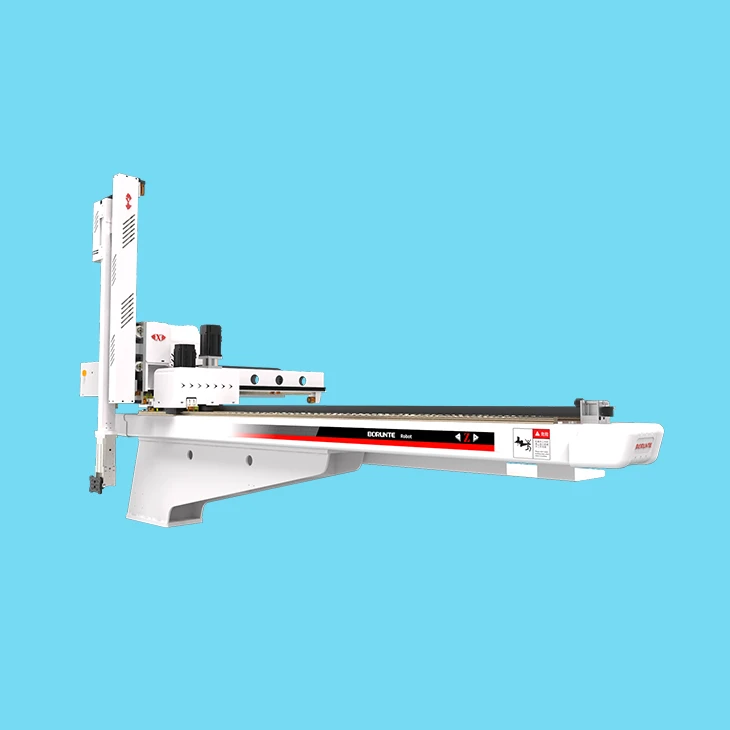
For injection molding lines, rotary motion is key for flipping parts, orienting them, or placing them onto a conveyor at an angle instead of straight on. Our Three Axis Injection Machine Manipulator line, for example, combines linear and rotary motion to reach into the mold, lift the part, rotate it 90 degrees, and set it down-all in a single smooth sequence. The beauty of pneumatic rotary motion is its power-to-size ratio: a small vane actuator can generate enough torque to rotate a part weighing several kilograms, even in tight spaces around a mold.
What's more, rotary motion in pneumatic robots is highly controllable. You can adjust the acceleration and deceleration of the rotation so that delicate parts-like a thin plastic bottle cap or a small electronic connector-don't get damaged mid-movement. I recently worked with a medical device client that was struggling with part breakage when their old servo robot rotated a tiny syringe component. Swapping to a pneumatic rotary wrist with adjustable speed controls fixed the issue entirely, and cut their part rejection rate by 15%. It's a small example, but it shows how versatile rotary pneumatic motion can be.

Combined Motion: Multiaxis Coordination for Complex Tasks
Now, here's where things get really interesting. The best pneumatic robots don't just move in a single axis-they combine linear and rotary motion to handle complex, multidirectional tasks. This is where multiaxis capabilities come in, and it's why many manufacturers now choose pneumatic systems over electric for high-speed, moderate-precision lines.
Let's talk about a dual-arm application, for example. Our Three Axis Dual Arm Robot line uses two separate pneumatic arms, each with their own linear and rotary motion, to perform tasks like picking two parts at once, assembling them, and placing them into a packaging tray. The coordination between the two arms is controlled by a simple PLC, which sends signals to the pneumatic valves to sync the movements. The result is a task that would take a single-axis robot twice as long, done in half the time.
Another example is palletizing. Pneumatic palletizing robots use multiple linear axes to move up, down, left, and right, plus rotary motion to adjust the angle of layers. The motion is repeatable across hundreds of cycles, and because pneumatic systems are often lighter than electric ones, they can operate at higher speeds without the need for heavy-duty floor supports. We've had automotive parts suppliers use pneumatic multiaxis robots to stack plastic door panels in warehouses, with each layer perfectly aligned every time-something that would be costly and complex to replicate with a hydraulic system.
Multiaxis pneumatic motion also has a big advantage in terms of setup. Unlike electric robots that need complex programming for each axis, pneumatic systems use intuitive adjustment knobs and limit switches to set positions. A line operator can reconfigure a pneumatic robot for a new product in a matter of hours, whereas an electric robot might take days of programming. That flexibility is a game-changer for small to mid-sized manufacturers that run frequent product changes.
Speed, Force, and Compliance: The Underappreciated Motion Superpowers
Beyond the basic linear, rotary, and multiaxis motions, pneumatic robots have two motion-related capabilities that make them stand out from other automation options: high speed and inherent compliance.
We already touched on speed, but it's worth emphasizing: pneumatic actuators can reach speeds of up to 5 meters per second for short strokes, which is unheard of for most electric robots. For high-cycle tasks like pick-and-place from a conveyor, that speed translates directly to higher production rates. Our 3 Axis Servo Robot line combines pneumatic speed with servo control for precise timing, perfect for lines that need both speed and accuracy-like handling small plastic parts that need to be placed on a circuit board in milliseconds.
Compliance is another superpower. Unlike rigid electric robots, pneumatic systems "give" a little when they encounter resistance. That might sound like a flaw, but it's actually a huge benefit for tasks where you need gentle contact. For example, when inserting a pin into a hole, a rigid electric robot might overpress and damage the part, but a pneumatic robot will stop or slow down automatically when it meets resistance, making adjustments on the fly. This is especially useful for assembly tasks with tight tolerances, and it's a capability you won't find in many hydraulic or electric systems without adding extra sensors.
We saw this firsthand with a client that was assembling automotive sensors. The pins had to be inserted into a plastic housing with only 0.2mm of clearance. Their old electric robot was breaking 10% of the pins because it couldn't adjust for minor alignment errors. Swapping to a pneumatic robot with compliant motion cut pin breakage to less than 1%, and the client saw a 10% increase in their overall yield. That's the kind of real-world impact that pneumatic motion capabilities can deliver.
What Pneumatic Robots Can't Do (Setting Realistic Expectations)
For all their strengths, it's important to be honest about the limits of pneumatic robot motion. They aren't the right choice for every task. For example, pneumatic systems have lower precision than top-tier electric servo robots-while they can hit 0.1mm repeatability, electric systems can often hit 0.01mm or better. If you need extremely precise positioning for micro-electronics or aerospace parts, a pneumatic robot might not be the best fit.
Another limit is the maximum payload. Pneumatic actuators generate force based on air pressure, so while they can handle most injection molding parts, packaging, and small assembly tasks, they aren't ideal for moving very heavy loads (over 50kg or so). For heavy-duty applications like lifting entire pallets of steel parts, a hydraulic or heavy-duty electric system is a better bet.
Also, pneumatic motion can be sensitive to air pressure fluctuations. If your shop's compressor isn't properly maintained, you might see variations in speed or position. That's why it's important to work with a supplier who can size the compressor correctly and set up regular maintenance plans-something we include with every pneumatic robot system we sell.
Choosing the Right Pneumatic Robot for Your Motion Needs
At the end of the day, the motion capabilities of a pneumatic robot make it an ideal solution for a wide range of manufacturing tasks: high-cycle injection molding, packaging, light assembly, material handling, and more. Whether you need a simple linear pick-and-place robot or a complex multiaxis system, there's a pneumatic robot that can be tailored to your specific needs.
If you're looking to upgrade your automation line and want to explore how pneumatic motion can improve your speed, flexibility, and yield, we're here to help. We work with manufacturers across every industry to design custom pneumatic robot systems that match your production requirements. From the Servo System Injection Manipulator for precision injection lines to dual-arm systems for high-volume assembly, we have the expertise to find the right solution for you.
We're ready to work with you to walk through your tasks, address any questions you have about motion capabilities, and help you find the pneumatic robot that will drive your production forward. Reach out to us today to start the conversation and take the first step toward more efficient, flexible automation for your line.
References
- Hollingum, J. (2021). Pneumatic Robotics: Principles and Industrial Applications. Industrial Automation Press.
- Wang, L., & Zhang, H. (2022). "Motion Performance Comparison of Pneumatic, Electric, and Hydraulic Robots for High-Cycle Manufacturing." Journal of Manufacturing Systems, 62, 412-421.
- International Organization for Standardization. (2019). ISO 10218-1: Robots and Robotic Devices for Industrial Environments – Safety Requirements – Part 1: Robots. ISO.
- Smith, K. (2023). "Compliant Motion in Pneumatic Manipulators for Delicate Assembly Tasks." Assembly Engineering Magazine, 27(3), 22-27.