

If you've ever spent time on a factory floor, you've probably seen industrial robots moving parts around, packing boxes, or welding things together. But have you ever wondered why some of these machines spin six different ways while others only move four? As someone who works with and sells 6 axis robots, I get this question all the time—especially from small business owners just starting to automate or old-school operators who've worked with 4 axis units for decades. The truth is, the difference between these two isn't just a number of extra joints; it's about what each can do, how flexible they are, and whether they're worth the investment for your specific line of work.
First, let's break down what those "axes" actually mean, because that's the base of everything. An axis is basically a joint that lets a robot move in a new direction. Think of your own arm: your shoulder rotates (that's one axis), your elbow bends (second), your wrist twists (third), and your wrist can also tilt side to side (fourth)—that's four axes right there. A 4 axis robot sticks pretty close to those basic arm movements, plus usually a linear slide for moving parts back and forth on a flat plane. A 6 axis robot? It adds two more joints to the wrist, making its movements way more like a human hand and arm combined. That extra range doesn't sound like a big deal on paper, but in practice, it changes every job it can handle.
Let's start with use cases, because that's where most people notice the real difference. 4 axis robots are like the workhorses for simple, repetitive tasks that stay on a single flat plane. Think of a pick-and-place line moving small parts from a conveyor belt to a tray, or a palletizer stacking boxes on a shipping skid. They're fast, they're affordable, and they don't take up a lot of space—perfect for when you just need to move something from Point A to Point B without any fancy twists or turns. But here's the catch: if you need that part to fit into a weirdly shaped spot, or if you're working with something that's not on a straight line, a 4 axis robot will struggle. It can't tilt or twist the end of its arm (the tool you attach, like a gripper or a welder) enough to reach tight corners or angled surfaces.
That's where a 6 axis robot shines. The extra two joints let it maneuver in 3D space, not just on a flat plane. For example, if you're doing stamping work where you need to move a metal blank from a feed, twist it to fit the die, and then lower it into place without scratching it, a 4 axis robot can't angle the gripper just right. Our team works with a lot of automotive stamping shops, and most of them switched from 4 axis units to our six-axis stamping robot for exactly that reason—being able to adjust the part's angle mid-move cuts down on defects by like 20% and speeds up changeovers between different car models. If you're in the stamping industry, checking out that link will show you exactly how we set those robots up for that specific job, with custom grippers and programming tailored to avoid scrap.
Another thing to talk about is flexibility, because that's the big selling point for 6 axis robots for most people who aren't just doing super simple pick-and-place. I've seen a 4 axis robot struggle to reach a weld spot on the inside of a car door frame because the arm can't angle enough— it has to move the entire door into a very specific position, which slows down the line. A 6 axis robot, though? It can reach around corners, fit into tight spaces, and adjust on the fly. We call this "dexterity" in the industry, and it's a game-changer for jobs like welding, assembly, or even quality inspection where you need to get close to parts from every angle. For smaller manufacturers who might switch between products every few months, not just once a year, that flexibility is huge. If you're looking for a robot that can adapt to different tasks without needing a total rework of your line, our six-axis automatizacion industrial robot line is built for that—you can reprogram it to do everything from packaging small electronics to assembling furniture parts without a ton of extra setup.
Now, let's get into the nitty-gritty of size and load capacity, because not all 6 axis robots are the same. A lot of people assume six axis means big, heavy, only for auto factories—but that's not true. We have a full range, from our six-axis desktop robot arm that fits right on a workbench for small electronics assembly or laboratory testing, all the way up to our large scale industrial robot arm that can lift 1,000+ kg for moving heavy construction materials or industrial equipment. The same goes for 4 axis robots: some are tiny for small parts, some are big for heavy pallets. But the key difference in size and load is that 4 axis robots tend to be stiffer for linear tasks, while 6 axis robots balance reach and maneuverability even at heavier loads. The large scale units, for example, still have all six joints, so even when lifting a big, awkward part, they can adjust its angle to set it down perfectly, which a 4 axis robot can't do without extra fixtures.
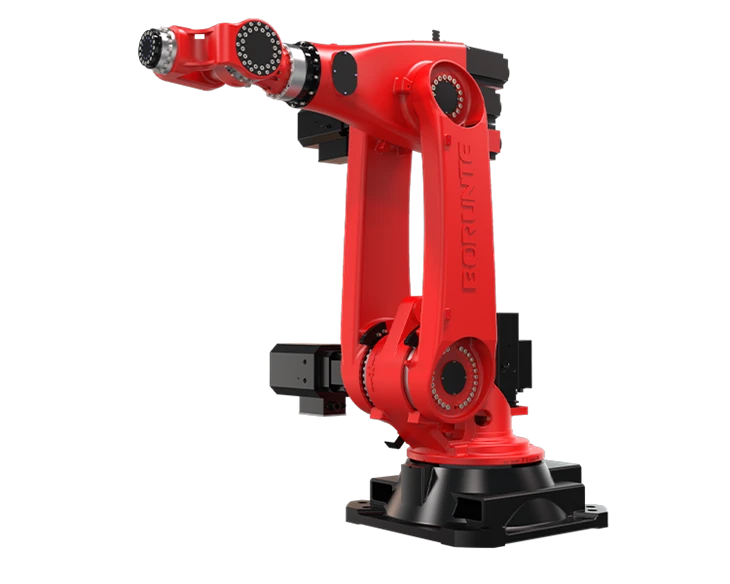

Speed and cycle time are other areas that people argue about. Some say 4 axis robots are faster because they have fewer joints moving, but that's only true for very simple, flat-plane tasks. Once the job requires any kind of 3D movement, the 6 axis robot doesn't need to waste time repositioning the entire part to fit its limited range, so the total cycle time actually ends up being faster. Let's take a simple example: moving a plastic bottle from a conveyor to a labeling machine. A 4 axis robot can do that quickly, no problem. But if that same line needs to print a QR code on the curved side of the bottle before labeling, a 4 axis robot would have to rotate the entire bottle to get the code aligned, while a 6 axis robot can spin the end of its arm (with a small printer attachment) around the curved bottle without moving the conveyor or repositioning the bottle. That cuts out a whole step, making the line more efficient.
Cost is obviously a big factor for most businesses, so let's be honest here. A 4 axis robot is usually cheaper upfront—like 30-50% less than a comparable payload 6 axis unit. That's why they're still the go-to for small businesses that only need simple pick-and-place or palletizing. But if you're planning to expand your automation down the line, or if your current line might change, the 6 axis robot's flexibility saves you money in the long run. You don't have to buy a new robot every time you add a new product or change a task; you just reprogram the one you have. That's a big reason why so many of our clients start with a small 6 axis robot—maybe a flexible robot for their assembly line— and then add more units as they grow, instead of locking themselves into 4 axis units that become outdated when their business changes.
Wait, let's also talk about programming, because that's a real pain point for a lot of operators. 4 axis programming is pretty straightforward—most people can learn the basics in a few days, since it's just moving along X, Y, and Z axes without the extra rotation and tilt. 6 axis programming takes a little longer, because you have to account for all those extra joints, but modern tools have made it way easier than it used to be. Our team uses software that lets you drag and drop waypoints on a 3D model of the part, so you don't have to manually calculate every joint movement. A lot of new operators pick that up in a week or two, and it's worth it for the extra flexibility you get.
I also want to mention a common misconception: that 4 axis robots are only for small jobs and 6 axis are only for big jobs. Nope, we have clients that use small 6 axis units for things like placing circuit boards on phones, and big 4 axis units for palletizing 500 kg rolls of steel. The number of axes doesn't dictate size—it dictates movement capability. That's why it's so important to match the robot to your specific task, not just go with what's popular or what's cheaper. If you're only moving boxes from the conveyor to a pallet, a 4 axis is fine. If you're welding car frames, assembling furniture, or stamping parts that need to fit tight dies, you need a 6 axis.
Let me give you a quick example from one of our clients to make this real. A few months back, a small aerospace parts manufacturer reached out to us. They'd been using two 4 axis robots to move small aluminum brackets from a mill to a test table, but they were having a problem: the brackets had 5 different angles that needed to be checked, and the 4 axis robot could only present the bracket at two angles. They had to move the brackets manually between each check, which took forever and led to a lot of human error. They swapped one of the 4 axis units for our six-axis automatizacion industrial robot, and suddenly they could present the bracket at any angle they needed, all in one automated cycle. They cut their manual labor for that task by 75%, and reduced defects from misaligned parts by almost 90%. That's the kind of difference the right robot makes, and it all comes down to those extra two axes.
Now, if you're reading this and trying to figure out which one is right for you, here's a quick cheat sheet. Go with a 4 axis robot if: your task is simple (pick-and-place, palletizing, basic material handling), everything stays on a single flat plane, upfront cost is your top priority, and you don't plan to change tasks much in the next 2-3 years. Go with a 6 axis robot if: your job requires working in 3D space (welding, assembly, stamping, inspection, or any task where parts need to fit into tight or angled spots), you might need to switch tasks or add products down the line, you want to reduce manual labor and defects, and you can invest a little more upfront for long-term flexibility.
At the end of the day, it's not that one is "better" than the other—it's that they're built for different jobs. 4 axis robots are simple, affordable workhorses for basic tasks, while 6 axis robots are more versatile, dexterous, and built for businesses that want to scale or handle complex work. If you're ready to talk about what your specific line needs, our team is here to help. We don't push one size fits all solutions—we'll listen to your tasks, your budget, and your future plans, and help you pick the right robot for you, whether that's our six-axis stamping robot for your metal work, a six-axis desktop robot arm for your small assembly lab, or our large scale industrial robot arm for heavy lifting. We also have a flexible robot line that's perfect if you need a unit that can handle multiple different tasks around your facility, no extra fixtures required.
Don't settle for a robot that can't keep up with your business's needs. Whether you're just starting out with automation or looking to upgrade your current line, reach out to us to chat through your options. We'll walk you through the differences, show you how each robot works for jobs like yours, and help you make a choice that grows with your business.
References:
Industrial Robot Association. (2022). "Understanding Axis Configurations in Industrial Robotics." Annual Robotics Report.
Miller, J. (2023). "Dexterity and Task Flexibility: A Comparison of 4-Axis and 6-Axis Robots." Journal of Industrial Automation.
ABB Robotics. (2024). Product Specifications for 6-Axis and 4-Axis Industrial Robot Lines.
National Institute of Standards and Technology. (2021). "Robot Performance Metrics for Manufacturing Applications." Technical Note 1936.