


With the continuous development and improvement of robotics technology, industrial robots will undoubtedly play a significant role in promoting the development of five major industries: automotive manufacturing, electronic and electrical industry, rubber and plastic industry, casting industry, and chemical industry. And China is moving from a manufacturing powerhouse to a manufacturing powerhouse, which requires improving processing methods, improving product quality, and increasing enterprise competitiveness. All of these indicate that the development prospects of robots are enormous.
This article provides an overview of the five major application industries for your reference:
1、 Automobile manufacturing industry
In China, 50% of industrial robots are used in the automotive manufacturing industry, with over 50% being welding robots; In developed countries, automotive industry robots account for over 53% of the total number of robots.

According to statistics, major automobile manufacturers around the world have an annual output of over 10 robots per 10000 cars. With the continuous development and improvement of robot technology, industrial robots will undoubtedly play a significant role in promoting the development of the automotive manufacturing industry. And China is moving from a manufacturing powerhouse to a manufacturing powerhouse, which requires improving processing methods, improving product quality, and increasing enterprise competitiveness. All of these indicate that the development prospects of robots are enormous.
2、 Electronic and electrical industry
Electronic ICs, SMD components, and industrial robots are widely used in these fields. At present, the most installed industrial robot in the world's industrial community is the SCARA type four axis robot. The second place is a series joint type vertical 6-axis robot.
In the field of mobile phone production, visual robots, such as sorting and packaging, film tearing systems, laser plastic welding, high-speed four axis stacking robots, etc., are suitable for the application of automation systems in a series of processes such as touch screen detection, scrubbing, and film sticking.

The robots in the special zone are specially designed by domestic manufacturers according to the needs of the electronic production industry. The miniaturization and simplification characteristics have achieved high-precision and efficient production of electronic assembly, meeting the increasingly refined demand for electronic assembly and processing equipment. Automated processing greatly improves production efficiency. According to relevant data, the product yield can be increased from 87% to 93% through robot polishing. Therefore, whether it is a "robotic arm" or a more high-end robot, its use will significantly improve production efficiency.
3、 Rubber and plastic industry
The cooperation in the plastic industry is close and highly specialized: the production, processing, and mechanical manufacturing of plastics are closely linked. Even in the future, this industry will remain an important economic sector and ensure numerous job positions. Because plastic is almost ubiquitous: from the automotive and electronics industries to the consumer goods and food industries. Mechanical manufacturing plays a crucial role as a process technology that connects production and processing. Raw materials are processed into innovative, fine and durable finished or semi-finished products for precision processing through injection molding machines and tools - through the use of automated solutions, the production process is more efficient, cost-effective, and reliable.
To enter the plastic industry, it is necessary to meet extremely strict standards. This is certainly no problem for robots. It is not only optimal for producing tools under clean room environmental standards, but also capable of completing high-strength operations near injection molding machines. Even in a high standard production environment, it will reliably improve the economic benefits of various processes. Because robots master a series of operations, picking and finishing operations.
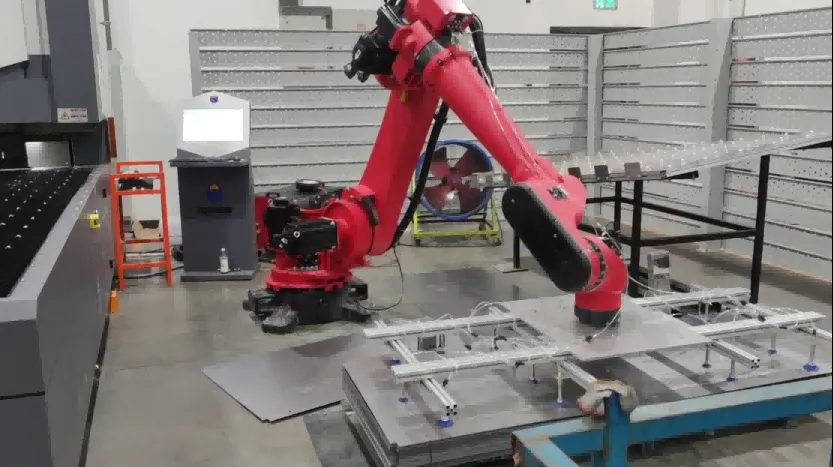
With its versatile nature, robots operate quickly, efficiently, and flexibly. It is sturdy and durable, capable of withstanding the heaviest loads. This can best meet the growing requirements for quality and production efficiency and ensure that enterprises have a decisive competitive advantage in future market competition.
4、 Foundry industry
Conducting multiple shifts in extreme working environments - casting operations place a heavy burden on workers and machines. Another reason for manufacturing strong casting robots specifically designed for extremely heavy loads is in areas with high pollution, high temperatures, or harsh external environments. The user-friendly control system and specialized software package make the application of robots very flexible - whether it is directly used for injection molding machines, for connecting two processes, or for transporting extremely heavy workpieces. Due to its advantages such as optimal positioning performance, high bearing capacity, and the ability to safely and reliably carry out high-strength operations.
Robots, with their modular structural design, flexible control systems, and specialized application software, can meet the highest requirements of the entire automation application field in the casting industry. It is not only waterproof, but also resistant to dirt and heat.
It can even be used directly next to, inside, and above the injection molding machine to remove workpieces. In addition, it can reliably connect process units and production units. In addition, robots perform exceptionally well in precision machining operations such as deburring, grinding, or drilling, as well as quality testing.

5、 Chemical industry
The chemical industry is one of the main application fields of industrial robots. The main clean robots and automation equipment currently used in the chemical industry include atmospheric robots, vacuum robots, clean coating robots, clean AGVs, RGVs, and clean logistics automatic transmission systems. Many modern industrial products require precision, miniaturization, high purity, high quality, and high reliability in production. A clean environment is required in the production of products, and the level of cleanliness directly affects the qualification rate of products. Clean technology is constantly developed according to the increasingly strict requirements, methods, and facilities for controlling pollutants in the clean production environment during product production. Therefore, in the field of chemical industry, as more and more chemical production occasions in the future demand higher environmental cleanliness, clean robots will be further utilized, so they have broad market space.