


In modern industrial production, robots have become a key tool for improving efficiency and accuracy. However, just as humans expand their space through transportation, robots also require specific devices to enhance their functionality and flexibility - this is the role of a positioner.
A positioner is a device that can be installed on industrial robots or workpieces to achieve overall movement and positioning. It can be understood as a "movable base" that can flexibly change the position of robots or workpieces. This device can provide robots with greater workspace and more degrees of freedom when performing complex tasks. Positioners can be standard components provided by robot manufacturers or customized according to specific user needs.
By using positioners, the range of action of industrial robots has been significantly expanded. Firstly, positioners can increase the degrees of freedom of robots, enabling them to operate from different angles and positions, which is particularly important for the assembly of complex components. Secondly, the positioner can also achieve collaborative operation of multiple robots or work objects, which is particularly critical in automated production lines and can significantly improve production efficiency and product quality.
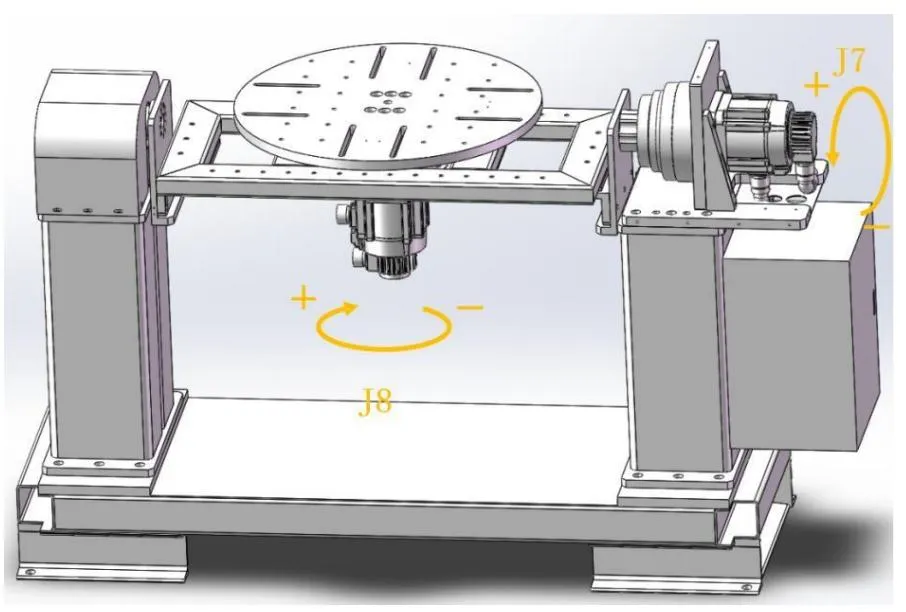
Positioners come in various forms, each designed for different industrial applications:
1. Rotary positioner: This type of positioner uses a rotation mechanism to achieve the rotational motion of the robot or workpiece within a certain range, and is suitable for tasks that require rotational machining or inspection.
2. Linear positioner: Linear positioners allow robots or workpieces to move along a linear path and are commonly used in assembly lines, welding operations, and other situations that require linear motion.
3. Multi-axis positioner: Combining the characteristics of rotary and linear motion, it can adjust the position in multiple degrees of freedom, greatly improving the flexibility of the robot and its ability to reach positions that are difficult to reach directly.
4. Customized positioners: Based on specific production needs, positioners can be customized to adapt to special work environments or specific robot configurations. These types of positioners are usually designed to solve complex or non-standard production problems.
Industrial robots equipped with positioners are like putting on skateboard shoes, not only enhancing the robot's functionality, but also greatly expanding its operating range and flexibility, making it an indispensable key component in modern automated production.