


The welding process plays an indispensable role in the modern manufacturing industry, carrying out a series of engineering tasks. However, its accompanying characteristics, such as light pollution, smoke and dust, splashing, electromagnetic interference, and high temperature, bring certain hazards and risks to workers. The addition of welding industrial robots is beneficial for improving the safety and production efficiency of the entire workflow.
Welding is a permanent joining technique commonly used to connect two or more metal or non-metal components together, achieved through heating, pressure, or a combination of both. It is a massive process system. This article explores the most widely used and important welding manufacturing process in welding - metal welding. According to statistics, there are more than 40 processes and methods for metal welding, which are generally classified as: ① brazing; ② Fusion welding; ③ Pressure welding.
Brazing:
Brazing is a method of connecting two or more metal parts by heating and melting a metal alloy called "brazing material". Unlike fusion welding, brazing materials have a lower melting point, so the connected parts will not melt during the brazing process. Brazing is particularly suitable for connecting different types of metals because we can select brazing materials with a melting point lower than that of the connected metal. This method typically requires less heat, making it suitable for situations where the structure and strength of the parts are critical.

Fusion welding:
Fusion welding is a method of connecting metal parts together in a molten state by heating and melting them. When metal parts reach a sufficiently high temperature, they will melt and form a sturdy welded joint after cooling. Fusion welding typically requires high temperatures and energy, which may affect the structure and strength of the parts. This method is particularly suitable for connecting metals of the same type.
Pressure welding:
Pressure welding is a method of connecting metal parts together by applying pressure without melting the metal. During the pressure welding process, metal parts are placed between two metal plates called "electrodes", and sufficient pressure is applied to connect the molecular structures between the parts. This method is usually used to connect thinner metal parts because it does not generate high temperatures in the material.
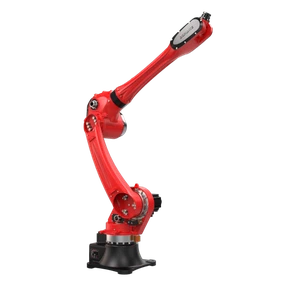
As a widely used process in modern industrial fields, welding is highly compatible with the industrial sector due to its hazardous environment, high repeatability, and complexity. Replacing manual labor with industrial robots is of great significance. Welding robots are industrial robots designed specifically for welding tasks, typically equipped with highly specialized sensors and tools. It has a series of characteristics: high precision, ability to operate in complex work environments, improved production efficiency, and consistent welding quality.
According to statistics, 60% of companies currently using industrial robots are in the automotive industry, with 50% of them being welding robots. They are widely used in manufacturing and industrial fields, and can effectively perform various types of welding operations such as arc welding, laser welding, gas shielded welding, etc.
Working principle: Welding industrial robots perform welding tasks through a pre-programmed instruction set. These instructions cover parameters such as welding path, speed, welding current, and voltage, and the robot controls the movement of the welding tool and various aspects of the welding process based on these parameters.
Mechanical structure: Welding industrial robots have multiple joints, with the most widely used being 6-axis robots, which allow them to move flexibly in multiple directions. The joints of the robot are controlled by motors and sensors, enabling it to accurately locate welding points.
Programming: Welding robots can set welding paths and parameters through offline programming or online programming (demonstration). Offline programming is usually done on a computer, and then instructions are transmitted to the robot. Online programming allows operators to guide robot movements through manual demonstrations.
Application areas: Welding industrial robots are widely used in fields such as automotive manufacturing, aerospace, metal processing, and building structures. They can improve production efficiency, reduce labor costs, and also enhance welding quality and consistency.
Advantages: Welding industrial robots have high repeatability and precision, can work in hazardous environments, and can operate continuously to maintain consistent quality levels. They can also perform tasks in environments such as high temperature, high pressure, and harmful gases, ensuring the safety of workers.
Due to the wide variety of welding types, specific welding tools are required to meet different needs when welding robots perform different welding schemes for different workpieces. Generally speaking, welding industrial robots are usually equipped with welding guns, welding torches, or laser welding equipment. These tools are capable of performing various types of welding operations to meet different material and welding requirements.
These end effectors are the final part of the mechanical structure of the welding robot, connected to the end of the robot and responsible for actual welding operations. End effectors are usually equipped with welding tools to perform welding tasks according to predetermined paths and parameters.
Welding gun: The Welding gun is the most common end effector of welding robots. It usually includes an electrode and a wire supply system. The welding gun transfers heat from the electrode to the workpiece by controlling the current and voltage, thereby melting the welding wire and completing the welding operation.
Welding torch: A Welding torch is similar to a welding gun, but more suitable for certain special welding applications, such as gas shielded welding. Welding torches can be protected by gas shielding to prevent oxidation and contamination of the molten pool.
Laser welding equipment: Laser welding equipment uses laser beams for welding. Laser welding can provide higher precision and control in certain specific applications, especially on materials that are sensitive to heat input.
Fixtures and retaining devices: In some cases, robots need to grip and stabilize workpieces to ensure welding accuracy. These fixtures and holding devices can fix the workpiece, allowing the robot to weld in the correct position.
The selection of end effectors for welding robots depends on the specific requirements of the welding task, including material type, welding method, welding position, and quality standards. The design and performance of end effectors directly affect welding quality and production efficiency.
In addition, to simplify the operation process of industrial robots and improve work efficiency, process packages for various processes are embedded in the programming system of industrial robots. The programming backend of welding robots will have a professionally developed welding process package, which is a set of pre-set instructions and parameters used to control the robot to perform welding tasks. These process packages include welding path, speed, current, voltage, and other related parameters to ensure that the robot can achieve the required welding quality and efficiency when performing welding operations. Of course, different brands of industrial robots will have different adjustments.
Welding path: The process package will define the welding path, which is how the welding tool (such as welding gun, welding torch) should move on the workpiece. This includes straight line segments, arc segments, and various possible trajectories.
Speed and Acceleration: The process package will set the speed and acceleration of the robot's movement. The adjustment of these parameters can affect welding quality, weld appearance, and production capacity.
Current and voltage: For arc welding (such as gas shielded welding and manual arc welding), the process package will specify the values of welding current and voltage. These parameters directly affect the penetration ability and quality of the weld seam.
Welding rate: The process package may also include settings for welding rate (length of welding per unit time) to ensure appropriate welding pool size and uniformity.
Gas protection: For gas shielded welding, the process package will define appropriate gas combinations and flow rates to protect the weld from the effects of oxygen and other pollutants.
Welding modes: The process package can also include different welding modes, such as continuous welding, pulse welding, intermittent welding, etc., to meet different welding requirements.
Preheating and post heat treatment: For certain welding applications, the process package may include preheating and post heat treatment parameters to reduce stress and improve welding quality.
Detection and Control: Advanced process packages may include machine vision and sensing technology for real-time detection of weld position and quality, and automatic adjustment of robot movements.
The above is an introduction to welding processes and welding industrial robots. If you have any questions, please feel free to leave a message.