


In the past, manual welding was generally used for material welding, but this method was slow in welding speed and accuracy could not be guaranteed. Therefore, in order to meet the needs of work, robots emerged as equipment to replace manual welding and improve work efficiency. As long as the robot is programmed in advance and everything is debugged, it's all done.
According to the International Organization for Standardization (ISO), industrial robots belong to the definition of standard welding robots. Industrial robots are a versatile, reprogrammable automatic control operator with three or more programmable axes, used in the field of industrial automation. In order to adapt to different purposes, the mechanical interface of the last axis of the robot is usually a connecting flange, which can be used to connect different tools or end effectors.

Generally, welding robot manufacturers install welding pliers or welding guns on their equipment for welding, cutting, or spraying. The equipment can adjust automatic welding according to special welding methods, which relatively saves production time. At the same time, using robots can save a lot of individual welding equipment.
1、 Robot welding can improve production efficiency
The robot has short response time, fast action, and a welding speed of 60-120cm/min, which is much higher than manual welding (40-60cm/min). The robot does not rest during operation, but workers do not rest during work, and the work efficiency of workers is also affected by mood. However, the robot does not have the above problems. As long as external water and electricity conditions are ensured, it can continue to work, with stable performance and low failure rate, which invisibly improves the production efficiency of the enterprise.
2、 Robot welding can improve product quality
During the welding process, as long as the welding parameters and motion trajectory are given, the welding robot will accurately repeat this action. Welding parameters such as welding current, voltage, welding speed, and welding extension length play a decisive role in the results.
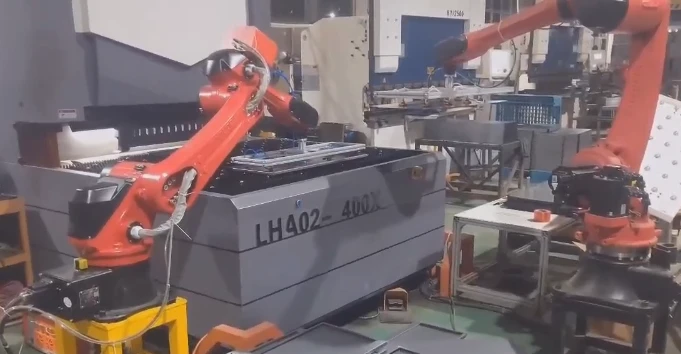
During welding, the welding parameters for each weld seam are constant, and the quality of the weld seam is less affected by human factors, which reduces the requirements for workers' operational skills. Therefore, the product quality is stable. During the manual welding process, both the welding speed and dry elongation have changed, making it difficult to achieve uniformity in quality, thus ensuring the quality of our products. 3、 Welding can reduce enterprise costs
Reducing enterprise costs mainly occurs in large-scale production, where a robot can replace 2 to 4 industrial workers, depending on the situation of the enterprise. Robots are fatigue free and can produce continuously 24 hours a day. With the application of welding technology, the cost reduction is more significant through the use of robots for welding.
4、 Robot welding makes it easy to arrange production plans
Due to the high repeatability of robots, as long as parameters are given, they will always follow the instructions to operate. Therefore, the robot welding product cycle is clear and it is easy to control product output. The production rhythm of robots is fixed, so the production plan is very clear. Accurate production planning should greatly improve production efficiency and comprehensively utilize resources. Welding robots have the advantages of improving production efficiency, improving product quality, reducing enterprise costs, and making production plans easier. Different robots and special robots can complete different tasks by changing the program flow.

There are still some differences between manual welding and robot welding, after all, manual welding is too slow, and there are various factors such as employees' leave and overtime, while robots do not. They can work 24 hours a day. It is recommended that relevant personnel choose products from legitimate welding robot manufacturers to ensure equipment quality and facilitate work.