


2.11 Stack
Click  button enters the following interface:

The stack types are classified as: general stacking box and stacking in the box data source stacking 4 yards four categories.
Generally, the general stacking of stacks can be divided into two categories: a rectangular shape, and as the name implies, a square object can be stacked;
Offset stacks can be stacked in a diamond shape or stacked on a slope (Z-axis offset).
Stack out the rectangular operation method:
1. First click the "New" button to create a new stack name or open a built file name.
2. Click “→” to enter the stack editing interface.
3. Set the starting point coordinates and spacing. There are two ways to set it up:
Use the three-point method to set up: The three-point method is to automatically calculate the offset and spacing using the three points that have been set.

The stack types are classified as: general stacking/ box and stacking in the box /data source stacking 4 yards four categories.
Generally, the general stacking of stacks can be divided into two categories: a rectangular shape, and as the name implies, a
square object can be stacked;
Offset stacks can be stacked in a diamond shape or stacked on a slope (Z-axis offset).
Stack out the rectangular operation method:
1. First click the "New" button to create a new stack name or open a built file name.
2. Click “→” to enter the stack editing interface.
3. Set the starting point coordinates and spacing. There are two ways to set it up:
Use the three-point method to set up: The three-point method is to automatically calculate the offset and spacing using the three points that have been set.
In the second step, move the robot to the starting position of the stack and then click the “Set In” button to set the current coordinate value into the coordinates edit box of each axis.
In the third step, move the manipulator to the next point in the X1 axis direction and then click the [Set] button to set the coordinate value to the X1, Y1 coordinates edit box. Then move the robot to the next point in the Y1 axis direction and then click the [Set] button to set the coordinate value to the X1, Y1 coordinates edit box.
Step 4 Click the [OK] button to return to the previous page for other settings.
Do not use the three-point method: Calculate the spacing manually.
In the first step, enter the interface as shown in the figure below. Move the robot to the stacking start point manually and then click the [Set] button to set the current coordinate value to the coordinate edit box of each axis.
In the second step, manually measure the spacing between the points in each axis and edit the spacing values into the corresponding edit boxes.
In the third step, set the direction of stacking of each axis, and the positive direction refers to the direction of the axis position + (press the axis button on the hand controller to identify the direction of the axis position).
4、 set the stack count, order, counter and run the order, the interface as shown below:

Arm selection: When using XYZUVW six axes, arm 1 is XYZ axis stack, arm 2 is UVW axis stack, arm 3 is ZUV axis stack, arm 4 is XYW axis stack, and the arm to be stacked can be selected according to the situation.
Count: Set the number of heap points on the axis.
Run Sequence: Sets the order in which each axis is stacked.
Counter selection: "self" means that the program runs a mode, the system default counter has been increased by 1; custom counter (in the action menu -> [counter] to set).
6, edit the data and click [Save] button.
7, playing √ "using the stack" in the "stack" in the choice of using the stack, and set the stack speed, choose a good location
in the program click on "set" to edit the stack to teach.
8, if the use of custom counters to be inserted in the process of teaching the stack counter plus 1 otherwise the counter does not count.
The offset heap method of operation:
The use of offset stacks can be piled into a diamond shape or stacked on a sloped surface (Z-axis offset)
1, first click the "New" button to create a new stack name or open the file name has been built.
2, click "→" to enter the stack editing interface.
3. Check the [Use Offset] option
4, Set the starting point coordinates and spacing.
Diamond-shaped heap when the starting point and spacing of the set there are two ways:
Use the three-point method to set: three-point method is to use has been set to automatically calculate the three points offset and distance.
The first step, in the manual state click "three-point method set" button to enter the edit page shown below.

In the second step, move the robot to the starting position of the stack and then click the [Set] button to set the current coordinate value into the coordinates edit box of each axis.
In the third step, move the manipulator to the next point in the X1 axis direction and then click the [Set] button to set the coordinate value to the X1, Y1 coordinates edit box. Then move the robot to the next point in the Y1 axis direction and then click the [Set] button to set the coordinate value to the X1, Y1 coordinates edit box.
Step 4 Click the [OK] button to return to the previous page for other settings.
Not using the three-point method: manually calculate the offset distance and spacing of the axis.
In the first step, enter the interface as shown in the figure below. Move the robot to the stacking start point manually and then click the [Set] button to set the current coordinate value to the coordinate edit box of each axis.
In the second step, manually measure the distance and offset between points in each axis and edit the spacing and offset values into the corresponding edit boxes.
The third step is to set the stacking direction of each axis, and the positive direction refers to the direction of the axis position + (press the axis key on the hand controller to identify) the reverse refers to the direction of the axis position.
X, Y offset effect map:
The effect of the X offset is shown below, with the left unbiased and the right shifted by the X offset.

Before unbiased After the offset
The effect of the Y offset is shown below, with the left unbiased and the right shifted by X offset.

Before unbiased After the offset
Inclined pile starting point, pitch setting mode:
The first step is to move the manipulator to the stack start position manually and then click the [Set] button to set the current coordinate value to the coordinates edit box for each axis.
In the second step, set the offset distance in the Z direction (default is Z in the X direction). If you want to offset Z in the Y direction, check the [Y direction offset Z] option.
The third step, set the stacking direction, count, order, counter and run the order.
Direction: Direction, direction of axis position +, direction of minus axis, axis direction.
Count: Sets the number of points to be stacked on the axis.
Run Sequence: Sets the order in which each axis is stacked.
Counter selection: "self" means that the program runs a mode, the system default counter has been increased by 1; custom counter (in the action menu -> [counter] to set).
The fourth step, edit the data and click [Save] button.
The fifth step, playing √ "using the stack" in the "stack" in the choice of using the stack, and set the stacking speed, choose a good location in the program click on "Settings" to edit the stack to teach.
The sixth step, if you use a custom counter to be inserted in the process of teaching the stack counter plus 1 or counter does not count.
Slope offset Stacking Example:
Suppose you need to pile up four circles in the following heap position

Teaching Page Setup:

Note: 1, because the counter is selected from the definition of the technology will need to teach more than one stack after the counter plus 1
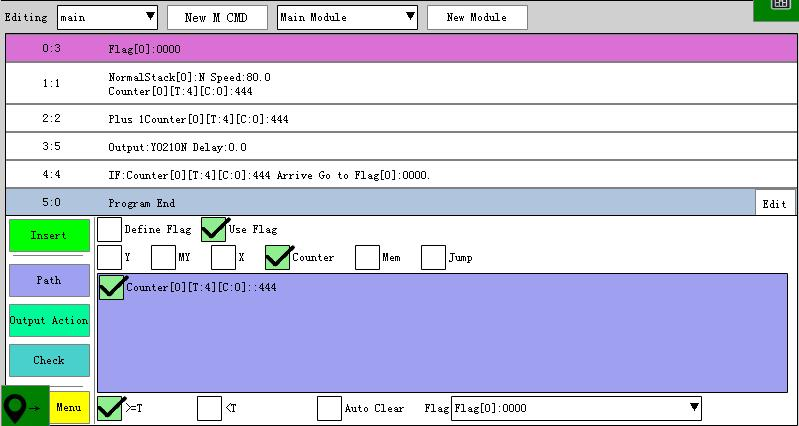
2, if the counter is full, such as after the start of the new conditions, the need to use conditions to clear the jump, conditional
Jump page settings as shown below:
General stacking usage example: Known conditions:
1. The size, width and height of the small square of the item are: 100*100*100(mm)
2, need to stack 3 products in the positive direction of XYZ
3, the product front and rear left and right distance 20mm each
4. The counter uses a custom counter, and a new counter called “stack counter” is added to the counter.
The specific settings are as follows:
The first step: first customize a counter.

Step 2: Enter the stack page and make the settings as shown in the figure below. Set all coordinates of the stack start point to 0.

The final heaping effect is shown in the following figure: Note: The serial numbers marked in the figure below indicate the order of the stacked products.

Stacking Original Point
Packing and stacking in the box and stacking in the box:
1. Select the “Packing and stacking in box” option.
2. Click “→” to enter the stack editing interface.
3. First click the "New" button to create a new stack name.
4. Set the spacing, quantity, order, direction and counter selection between the products in the first box under this interface.
5. Click “→” to enter the next editing interface. This interface sets the spacing, quantity, sequence, direction and counter selection between each stacking box.
6. Set all the data and click the Save button.
7. Hiccup [Use Stack] Select which stack to use in [Stack], and set the stacking speed. Select the location in the program and click “Set” to edit the stack into the teaching.
[Use Offset]: After checking, the set distance is offset from the previous stack point.
Example of stacking in the box: Known conditions in the box:
1. The size, width and height of the small square of the item are: 100*100*100 (mm).
2. There are 3 products in the XYZ direction, and the total number of products in the box is 27.
3, the product front and rear left and right distance 20mm each
4. The counter uses a custom counter, and a new counter called “box counter” is added to the counter.
The teaching page is as follows:

Known conditions outside the box:
1, a total of 4 boxes
2. It is necessary to stack 2 boxes in the positive direction of the X axis, stack 2 boxes in the positive direction of the Y axis,
and stack 0 boxes on the Z axis. The stacking order is: X→Y→Z.
3. The distance between the boxes is 500mm and the distance between the top and bottom is 0mm. The teaching page is set as follows:

The final heap effect is shown in the figure below.:

Data source stacking
Data source stack usage:
1, select the "data source stack" option.
2, first click the "New" button to create a new stack name.
3, click "→" to enter the stack editing interface.
4, select the data source type, the data source type is divided into two types of irregular points (for irregular stacking), such
as select this and then click "Edit Point" into the edit point box on the specific editing specific user ID.
5, playing √" "use stack "stack" in which to choose which stack to use, and set the stack speed, select a good location in the program click on "set" to edit the stack to teach .


Data source type option "irregular points" and then click "edit point" button to enter the point editing interface as shown below:

"Replace position": Click the edited position Click "Replace position" button to replace the old coordinate position with the current position.
"Synchronization Replacement": If the user has the position drawing and the starting coordinate of the drawing is inconsistent with the origin coordinate of the manipulator, it can be easily set in the irregular point by synchronous replacement.
Click the first point to change the coordinate value of the current point to the coordinate value of the origin (first point) of the drawing, and then click the [Save] button, as shown in the following figure:

Dedicated user ID display interface:

Example of irregular stacking: Take the example of stacking 6 irregular points on a horizontal plane.
After setting the six positions on the point editing page and selecting the counter, you can complete the setting as shown in the following steps:
Enter the following interface, pull down the data source triangle arrow and select “irregular point”.

2. Click the [Edit Point] button to enter the edit point box to teach six positions.
3. Select the counter type. The default is to select its own counter.
Can be stacked as shown below:

Use the artboard function: Click the "Artboard" button to enter the following page.

Check the “brush” to set the position of the XY axis and the height of the pen. If you select a smooth or straight line, you can write in the light blue edit box. If you write incorrectly during writing, you can click the “Clear” button. Clear all and rewrite, as shown below:

Clicking the "Calculate Path" button after writing is done will automatically generate the point, then click Close.

The automatically generated points can be viewed by clicking "Edit Points":

press“save” and inserting the stacking action to the main program

2.12 custom alarm
Press “custom alarm” button to enter this interface:

Select the alarm No and press 【insert】 to insert the alarm part to the program,when it runs to the alarm part, the robot will alarm and stop. The content of custom alarm can be modified, we have a software for it, if you need please contact us.
2.13 module
Click【model】to enter this interface,we can call module in here:

Create a new module:press【new module】→insert module name→【save】→set the program in the module→【save】.
Delete module:pull down module menu,select module and press【delete】.
Way to insert module:drop down“call module”and select the module need to be inserted in the menu→drop down“return to flag”(remark:please define the flag before you insert)→ select the line and press【Insert】.
2.14 Visual instruction
press Vision button to enter the following interface:

select data source:select “catch”,select a certain output,set the action time,action time and interval time,it means a certain output catch time,the interval time for catching,and times for catching,insert this to the program then enter the vision interface to set the wait time,if it failed to catch, the robot will alarm
For an example,we set output Y15 to catch for 2s,the interval time for output is 3s,after three times for catching, 2s later, if the camera failed to catch, the robot will alarm ,the parameter setting is as below pictures:


2.15 Path speed
Click path speed button to enter the following interface:

function:adjust the trajectory movement speed
Scope:only applies to the straight line in the path and curve movement
Original speed:If it is inserted between the straight line and curve,the original speed will the same as the one with a faster speed.
2.16 Data command
Click Data command to enter the following interface:

Function of origin command:set the sequence and speed of each axis homing
The way back to the origin is divided into six kinds, the user can choose according to
their own institutions::
1、 manually set the origin plus switch.
Set a random position with origin signal as home position manually,then this will be the origin position for every homing .
Process for setting the home position:
In manual mode, adjust all axis to the origin switch,(the switch light is on)→ in stop mode, enter“settings”→“machine setting”→“motor configs”,click 【set to origin】or【factory set all origin】,then 【save origin】.
2、Find the Z pulse directly。
Process to set home position by finding the Z pulse signal of motor:
In manual mode, adjust all axis to the origin switch,(the switch light is on)→ in stop mode, enter“settings”→“machine setting”→“motor configs”,click 【set to origin】or【factory set all origin】,then 【save origin】.
When robot need to be home,in the manual mode, press 【origin】then press【start】.
3、Short origin(automatically set the origin plus switch).when backing to origin, when it hits the origin metal plate, the home process finished when the origin switch is on.
First time to set origin or modify the way back to origin:press 【origin】then press【start】button, robot will go home as the sequences. When each axis finished backing origin,it will alarm and ask“origin has been changes,reset the origin position?”if you need to reset, press the 【reset origin】,if you don’t need to reset , press【stop】option.
4、automatically set the origin plus switch (long origin)。When homing,it hits the origin metal plate, it still go over the metal plate, the end of the plate is the origin position.
5、Mid origin,The middle point of the metal plate is the origin.
6、similar origin, when homing,when each axis is near to the origin position with origin signal,it is the origin press
【origin】then press【start】button, robot will go home as sequence, when axis go to the position near to the origin,the system will think it has been in the origin.
Remark:
1、The origin instruction must be edited in the programmable button [0] (serial number 0).
2、When program, the sequence of inserting is the sequence for homing。
3、in this interface, we can set the speed for homing(remark:the speed can’t be too fast otherwise it will cause collision)
remark:in the stop mode, actual speed=origin speed(value of motor)*axis speed
4、axis can do the home movement simultaneously by inserting the simultaneous start and end.
2.17 CAN command
Press CAN command to enter Can command interface:

remark:this function only can be used in the CAN internet communication mode
2.18 And Or Action
Press”And Or Action”to enter following interface:

And Or Action are used for waiting for signals,And action means robot must wait for several signals at a time,if lack of any of the signals, the robot will alarm. Or action means it needs to wait for signals, when robot receive any of the signals, the robot will not alarm.
2.19 extend
click extend button to enter this interface:

2.19.1 Route inside address

The route inside address function is to run the route by using the address. Before use this function, we need to set the parameter for the address.
Inside address:it can be 800-890 address.
Types of address: line 3D, posture line and free path.
line 3D:it is only used for XYZ axis to run line,If the address is 800,X axis is 800, Y axis is 801, Z axis is 802.
Line 3D pose:use XYZUVW six axis to run line 3D pose,if the inside address is 800,X axis is 800, Y axis is 801, Z axis is 802, U axis is 803, V axis is 804, W axis is 805805
Free point:Use XYZUVW six axis to run free points,,if the inside address is 800,X axis is 800, Y axis is 801, Z axis is 802, U axis is 803, V axis is 804, W axis is 805805
2.19.2 Save point

Save point function is to save the present point as memory,when we press stop button and restart it, the robot will run the points again
Save types:world coordinate- XYZ、world coordinate- XYZUVW、joint coordinate,world coordinate XYZ only save world coordinate of XYZ axis,world coordinate XYZUVW only save the world coordinate of XYZUVW axis,joint coordinate save the joint coordinate of XYZUVW.
save address:address 800-890 can be saved
Action choose:only current pos and current pos add deviation.
2.19.3 Analog control

Chanel:6 Chanel can be used.
Analog value:setting range is 1-6.
Delay:delay time for analog value.
2.19.4 Safety area

√safe range and set the safe range for the axis.
The setting range for limited axis and limit axis is 801~899 ,value(801~899)doesn’t represent the exact distance, it represent the address,the exact distance needs to set in the data command.
example:If X axis is 300~500, Y changed or Y is 0~100,the alarm will be “5001”.
First Step:setting for limited axis range remark: 801/802 is not a distance concept,actual distance range should be set in data command:
Less than X axis(limited axis) setting:

More than X axis(limited axis )setting:

Second step:limited axis condition setting 1:When Y axis(limited axis) changed,it will be a alarm “5001”.

When Y(limited axis) is out of 0~100 range, it be be a alarm No“5001”.

Remark: 803/804 is not a distance range. Distance range should be set in data command, way of setting is as the picture
show:set Y(limited)MINI range:

Set limited axis Max range:

2.19.5 Axis mepos

This function is for memorizing last position.as the pic shows: Y will go to position 20 with a speed of 80 ,then it will continue to go with the speed of 10,when there is a signal in X010,if the position is 60, it will remember this position. When next module starts, Y axis will run in the speed of 80 to the position 60, the rest of 40, it will run in a speed of 10. when there is signal of X010, it will remember this position.
remark:
1: if we set position as 30,for the fist action, Y axis will go with a speed of 80 to the position 50
2: saving address should be 800--899 .
2.19.6 Switch tool

2.19.7 Switch gesture

2.19.8 Torque range

2.19.9 Physical speed en

2.19.10 routeaccset

2.19.11 Set servoEn
We can make the servo function on or off in this interface.

When the program runs to “set servoEn”:X off;Y on;” X axis servo is off, Y axis servo is on,it will alarm because
the X axis servo is off.