


Sales of global service robots soared by 37%, with the most popular applications in five fields
Introduction: According to statistics, about 121,000 professional service robots will be sold in 2021, and more than one-third of them will be logistics robots, mainly used for cargo transportation. Therefore, most of the logistics robots will be in indoor environments, and the huge demand will make 286 manufacturers of logistics robots.
Recently, the International Federation of Robots (IFR) released the report World Robots-Service Robots in 2022, summarizing the development of global service robots in the past year.
The report shows that in 2021, the sales of global professional service robots will increase by 37%, with an amazing growth rate. By region, Europe has the strongest growth, accounting for 38% of the market share, followed by North America, 32%, and Asia, 30%.

Professional service robots in five fields are the most popular
Marina Bill, president of the International Federation of Robots, said: "The service robots used for professional purposes are very diverse. They are usually designed to perform specific tasks. They can be found in warehouses, hospitals and airports, and even help dairy farms milk automatically."
The International Federation of Robots summarized the five types of professional service robots with the largest sales volume in 2021, which are logistics robots, hotel robots, medical robots, professional cleaning robots and agricultural robots.
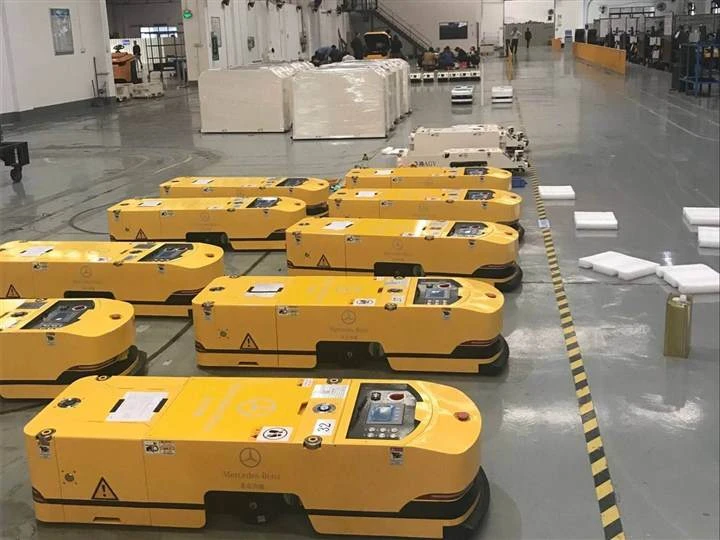
The first is the logistics robot. According to statistics, about 121,000 professional service robots will be sold in 2021, and more than one-third of them will be logistics robots, mainly used for cargo transportation. Therefore, most of the logistics robots are in indoor environments, and the huge demand has made 286 manufacturers of logistics robots.
The second is the hotel robot. Although it has increased by 85% year on year, its market share is still small, with only 20,000 sold. At present, the most widely used scenario of hotel robots is meal delivery and remote service.
The third is medical robots, with a year-on-year growth of 23% to 14,823, most of which are surgical robots, followed by robots for rehabilitation and non-invasive treatment. The share of robots for diagnosis is still relatively low.
The fourth is professional cleaning robots. The sales volume of such robots increased by 31% to more than 12,600, mainly due to the demand for sterilization in various scenes of the COVID-19, the demand for robots that spray disinfectant and use ultraviolet light to eliminate viruses has increased significantly. In addition, the cleaning of scenes such as window glass, swimming pool and solar panels has gradually been occupied by robots.
Finally, there are agricultural robots. In 2021, more than 8000 agricultural robots will be sold, an increase of 6%. Different from common expectations, the biggest application scenario of agricultural robots is not farming, but milking, barn cleaning, etc. There are still not many robots used for planting, mainly because the planting scenarios are complex, and most robots that can only do simple and repetitive work are still unable to adapt.
Slow growth of consumer service robots
Marina Bill, president of the International Federation of Robots, said: "Consumer oriented service robots are mainly used in the home environment: they are helpful for vacuuming, floor cleaning or gardening, and also used for social interaction and education. These service robots are produced for the mass market. Compared with professional service robots, their pricing and marketing methods are completely different."
In 2021, the sales volume of new consumer service robots will increase by 9%, mainly including household cleaning robots, gardening robots and nursing robots.
The number of service robots used for housework is the largest. In 2021, nearly 19 million sets will be sold, with a year-on-year growth of 12%. Specifically, floor sweeping robots and other robots used for cleaning indoor home floors are the most common. This kind of service robots has become popular and it is very convenient to buy.
In addition, gardening robots, including lawn mowing robots, are expected to grow at an average annual double-digit growth rate in the next few years.
Finally, as the aging of the population intensifies, nursing robots for home use will be a growing good market.
Change in the competitive situation of service robots
This report analyzed the industrial structure of service robots. The International Federation of Robots found that although service robots are a young and developing industry, 87% of the manufacturers in the industry are old brand enterprises, which were established before 2017.
The report points out that the share of start-ups has been declining in recent years, mainly because the industry has shifted its focus to software and applications. Many service robot suppliers no longer develop their own hardware, but use third-party hardware products. They develop their own software on this basis. These manufacturers are not regarded as service robot manufacturers.
To explore the underlying reasons for this change, on the one hand, the current market segments such as sweeping robots and logistics robots have reached a certain degree of saturation, and the strength of start-ups is insufficient. It is difficult to adhere to the asset heavy production model, but it is easier to succeed in the asset light operation model that favors software development.
On the other hand, the current stock market has the demand for secondary development. Through constant iteration of software systems, some application problems of service robots can be solved. Therefore, it is also a good choice for start-ups to shift from hardware development to software development and application development.