


The movement of industrial robots not only requires reliable driving devices but also efficient transmission units to achieve precise control. These two are important parts of industrial robots besides the mechanical body. This article will introduce the driving devices and transmission units of industrial robots to help you gain a deeper understanding of these key components.
1 Drive device
The driving device is the power source of the industrial robot arm, which enables various parts of the arm (including the body, arm, wrist, and hand) to move. Industrial robots typically use three basic types of driving methods: hydraulic drive, pneumatic drive, and electrical drive. Electrical drive is currently the most commonly used method for industrial robots, with AC servo motors being the most common choice. The arrangement of the driving device is usually one joint corresponding to one driver, which helps to achieve precise control and efficient movement.
At present, except for a few robots with low motion accuracy, heavy loads, or explosion-proof requirements that use hydraulic and pneumatic drives, most industrial robots use electrical drives, among which AC servo motors are the most widely used, and the driver layout mostly uses one joint, one driver.

2 transmission units
The transmission unit is an auxiliary component of the driving device, responsible for transmitting the motion of the driving device to various parts of the robotic arm to ensure that the end effector can accurately achieve the desired position and posture.
Industrial robots typically use reducers as their mechanical transmission units, which have specific requirements when compared to conventional reducers. The joint reducer of robots needs to have some characteristics, such as a short transmission chain, small size, high power, light weight, and easy control. These features help robots achieve efficient motion control.
In articulated robots, two main types of reducers are typically used: RV reducers and harmonic reducers. These precision reducers play a crucial role in enabling the servo motors of the robot to operate at the appropriate speed and precisely reduce the speed to meet the requirements of various parts of the industrial robot. At the same time, these reducers can also improve the rigidity of the mechanical body and output greater torque to meet the working requirements of the robot.
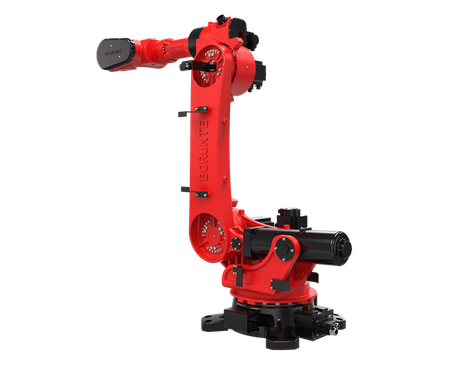
Generally speaking, RV reducers are mainly placed in heavy load areas of robots, such as the body, waist (the support part of the robot arm), and boom. This type of reducer is typically used to handle robot joints weighing over 20 kilograms. Harmonic reducers are more suitable for placement in light-load areas of robots, such as the forearm, wrist, and hand. Harmonic reducers are mainly used for robot joints weighing less than 20 kilograms.
The movement of industrial robots not only requires reliable driving devices but also efficient transmission units to achieve precise control. This article will introduce the driving devices and transmission units of industrial robots to help you gain a deeper understanding of these key components.
The driving device and transmission unit of industrial robots are key components for achieving efficient and precise motion, and their selection and configuration play an important role in the performance and application of robots. Different types of driving and transmission methods are suitable for different industrial robots. Choosing appropriate components based on specific needs will help improve the efficiency and accuracy of the robot's work.